
🏡💚 Everyone hates corporate landlords
As a brief PSA here at the top: I’ve mentioned previously that Mailchimp has made changes to their free plan that significantly reduces how many people you can send to, essentially making it impossible for me to continue using that platform for this newsletter. So, I’ll likely be moving this over to Substack in the coming weeks. I will plan on adding all of the current subscribers to that new list, but will also give you a way to opt out if you don’t want to receive more of these in your inbox. Also — if you have recommendations for non-Substack platforms that you would recommend, please let me know!
Ok, on to today’s newsletter about…
Corporate landlords. Everything about that term is gross. Take one thing most people hate (corporations) added to another thing that most of us generally dislike (landlords), and the combination sounds even worse than the sum of its parts. That’s why it’s such a good messaging tool — it’s both descriptively accurate, and instinctively repellant. And it invites a fairly big tent of people to come together in opposition. Renters, homeowners, and even small “mom-and-pop” landlords can all unite in their criticism of corporations acquiring and managing more and more rental properties.
In fact, that big tent is probably even bigger than you think. Guess who made this statement earlier this year:
“For a very long time, buying and owning a home was considered the pinnacle of the American Dream. It was the reward for working hard, and doing the right thing, but now… that American Dream is increasingly out of reach for far too many people, especially younger Americans. It is for that reason, and much more, that I am immediately taking steps to ban large institutional investors from buying more single-family homes.”
That was none other than President Trump writing on Truth Social. After the announcement, several major real estate companies saw their stocks tumble, including Invitation Homes, which has a bad track record of acquiring homes in California and letting them fall into terrible conditions.
A few weeks later, Trump signed an executive order that aims to prevent Wall Street investors from buying single-family homes. In that executive order, he writes, “Hardworking young families cannot effectively compete for starter homes with Wall Street firms and their vast resources. Neighborhoods and communities once controlled by middle-class American families are now run by faraway corporate interests. People live in homes, not corporations.”
Fascinating. He could have pulled that language directly from some of our coalition’s materials.
This is not meant to praise Trump, and much of the reporting and analysis has made a point to say that this is unlikely to significantly move the needle on housing affordability. For one, private equity owns much more multifamily apartment buildings, and this only applies to single-family homes. And beyond that, the housing crisis is much more complex than just the issue of Wall Street investments in single-family homes.
More than anything, I think this really speaks to just how much everyone across the political spectrum is against the idea of corporate landlords. It’s a populist message, and something Trump can try to point to at a time when Affordability is on everyone’s mind.
And, it’s still worth saying that there is real concern about the expansion of Wall Street into the single-family home market. This took off in the wake of the 2008 financial crisis, when large corporate firms started buying up distressed and foreclosed homes. Even if Trump is doing it for politically calculated reasons, it demonstrates how successful campaigns have been to bring that issue into broad public understanding.
In a strange parallel, during the same week Trump made his Truth Social post, Governor Newsom also pledged to crack down on corporate landlords. In his State of the State speech, his comments were bizarrely similar to those made by Trump: “It’s shameful that we allow private equity firms in Manhattan to become some of the biggest landlords in many of our cities… Over the next few weeks we will work with the Legislature to combat this monopolistic behavior, strengthen accountability and level the playing field for working families.”
So far, it’s unclear what exactly he has in mind. There have been numerous bills in the past few years aimed at taking on corporate landlords. Similarly to Trump’s proposal, most of these have aimed at banning large institutional investors from buying up single-family homes. Back in 2021, one bill (AB 1199) would have imposed an exise tax on corporate landlords, generating up to $1 billion annually. Something like that could go a long way in both targeting corporate landlords and bringing in sorely needed revenue (say for, I don’t know, green social housing?).
To circle back to where we started, talking about corporate landlords is a common theme in our own campaign for green social housing because it is such an effective narrative frame. Not only do most people naturally dislike corporate landlords, but the very idea also helps frame a deeper truth about housing in our current system: that it is treated as a speculative asset for profit — and like many other things in the economy, it is rigged in favor of the mega wealthy who continue to extract as much from our communities as they can. The point is not to say that by stopping corporate landlords we can solve the housing crisis, but that corporate landlords themselves are the most grotesque symptom of a system that will never be able to affordably house everyone because that is not what it is built to do.
The fact that this has made odd bedfellows of a fascist, an establishment Democrat, and housing justice advocates is a bit perplexing, but it’s also an opportunity. Clearly, this issue has resonance across the political spectrum, and the question is what we will actually do to address it. It’s possible that this only results in half-measures that are more symbolic than anything else. Or maybe we can channel that energy into a much more transformative vision, one that is not just a feel-good morality tale, but also a way to break through the political deadlock of housing politics that can’t see beyond the market-based system for answers.
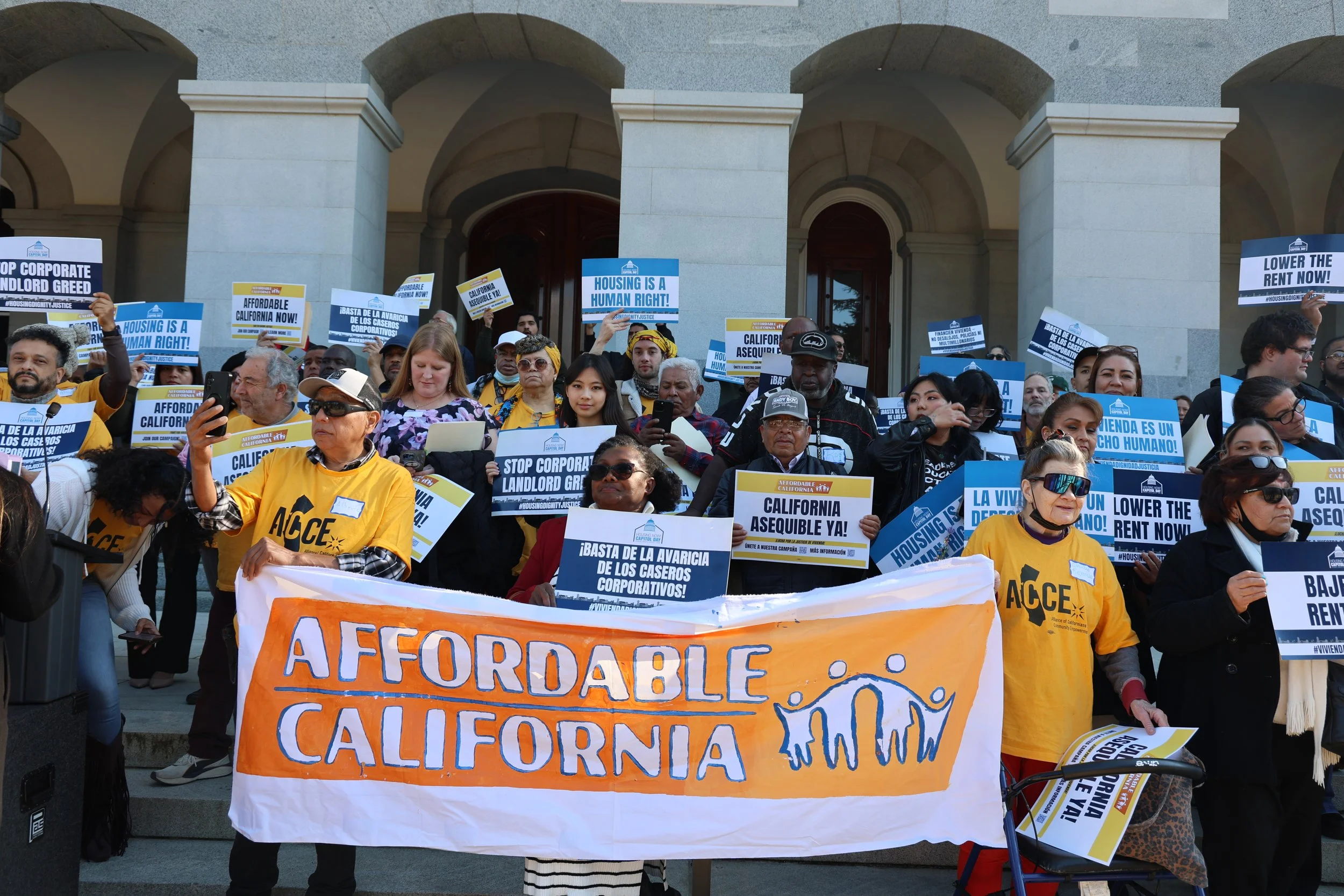
I used this same image last newsletter, but it applies just as well to today’s (see the signs saying “stop corporate landlord greed”) Source: Housing Now
WHAT WE’RE READING
More NYCHA Apartments to Get Climate-Friendly Heat Pumps (City Limits) — Zohran doing his thing. I’ll write about this soon!
Are YIMBYs winning the housing wars? Not so fast, these people say. (Washington Post) — surprising to see from the Washington Post
Can cities make landlords care about energy efficiency? (Grist)
Disaster Insurance for All: Our Proposal for Reforming Property Insurance (New America)
Scattered Homes, Shared Landlords: The Changing Landscape Of Tenant Organizing (Shelterforce)
L.A. unions push new tax on companies with ‘overpaid’ CEOs (LA Times) — more badass campaigns from our friends in LA
LA cities have programs for landlords to get around rent control. But they’re rarely used (LAist) – featuring some great quotes by Chelsea Kirk at SAJE and Shanti Singh at Tenants Together
Feel free to reply any time! I always enjoy hearing from people and getting any feedback/questions/additional thoughts.
We send these out on a somewhat weekly basis. If you don’t want to get these newsletters, feel free to unsubscribe below. If you know someone that would be interested, send me their email, or you can forward this along to them and they can use this link to subscribe.
