
🏡💚 Using swords to fight the housing crisis
“The average squatter,” says James Jacobs, “has no melee experience.”
This is the incredible opening line of story in Oaklandside this week. The article(which I highly recommend reading in full) profiles James Jacobs, a man who has made a job out of kicking squatters out of vacant homes.
He runs a business called “ASAP Squatter Removal,” getting hired by landlords when they discover people are occupying a property without authorization. Rather than going to the police (who sometimes don’t respond), or going through a more lengthy court eviction process, they turn to Jacobs. For a fee, Jacobs will remove the squatters by any means necessary. And if force is required, he comes prepared with an arsenal of homemade melee weapons and military tactics: a sword, a “spear” he’s made out of a broomstick with knives attached to the end, flash bangs, and smoke grenades.
Like many things about this moment in history, this story is both hilarious and terrifying. Jacobs is cartoonishly evil — a sword-wielding maniac fighting on behalf of landlords. I mean… look at this guy:

(Yes, that is a grenade he is holding in his left hand).
It would be so funny if it wasn’t so heartbreaking. In some ways, this kind of dark humor feels like the defining sentiment of our times. Our ruling class overlords are complete buffoons; utterly detestable, and wildly entertaining. Whether it’s Peter Thiel’s quest to make sure people know he’s definitely not the anti-Christ (while unable to straightforwardly say humanity should continue to exist), Elon Musk’s public meltdowns on X (the company he bought, made much worse, and changed to the stupidest name you could think of), or Bezos renting out the entire city of Venice for his wedding. We have a reality TV guy as president, and part of Newsom’s heralded efforts to “fight back” consist of tweets in all caps mocking Trump’s style. It’s politics as spectacle.
This isn’t to equivocate between the ruling elite and James Jacobs, a small-time mercenary who is just trying to get paid. Jacobs represents a cottage industry of a few different squatter removal companies. These are parasitic businesses meeting a demand that arises out of this stage in our housing crisis. There are enough people who are homeless and desperate, and insufficient public services to do anything about it (whether it’s police support for landlords or, you know, real solutions to help people).
Squatting is a fairly well-known and old phenomenon. In the US, England, and other industrial countries, it has frequently been used as a political tactic, with roots in the anarchist and punk scenes of the ‘60s and ‘70s. More recently, it has been used for more high-profile political acts.
In 2019, Moms 4 Housing intentionally occupied a vacant house in Oakland to draw attention to the injustice of the housing crisis in the Bay Area. This brought activist Carroll Fife into the spotlight, who now serves on Oakland’s City Council.
During the pandemic, the Reclaimers occupied vacant, Caltrans-owned homes in El Serano (Los Angeles) that the agency had purchased for a freeway extension that never happened. For the Reclaimers, this personal act of dignity is also a political act, exposing the lived reality of people experiencing homelessness while homes sit vacant nearby.
There are many, many more cases of squatting that are not widely known and politicized. Especially since the 2008 financial crisis, squatting has increased as an act of desperate necessity. (At the time, squatters were often portrayed as “scammers’ out to trick landlords, rather than the fallout of a growing housing crisis). In the Oaklandside article, Christine Hernandez shared her family's story of squatting in an abandoned house in Fruitvale. Hernandez, who is now the director of resident empowerment at the Sustainable Economies Law Center, is open about her story to dispel the myth that “all squatters are bad and engaged in illicit activity in properties.”
The rise of squatting is not just about the increased number of people experiencing homelessness. It’s also about the rise in vacant and abandoned homes — especially since the 2008 foreclosure crisis. There is something so deeply immoral about these two social ills coexisting side-by-side. As the Reclaimers make clear on their website, there are more vacant homes than people experiencing homelessness in Los Angeles. It is one of the great indictment of our times, one that you hope future generations will look back on in disbelief.
Work is being done to try to revitalize abandoned homes. In Richmond, the city used a social impact bond and partnership with the Richmond Community Foundation to create the Housing Renovation Program. This is a revolving fund that acquires abandoned and deteriorating properties, fixes them up, and sells them to first-time homebuyers. They’ve partnered with Marin Clean Energy (MCE) to develop all-electric solar-powered homes that form a virtual power plant. Previously, these properties often cost the city thousands of dollars a year through attempts at code enforcement and clean up. Now they are high-quality homes that are made affordable to Richmond residents.
There have been other policy attempts to address the problem of vacant homes. A number of Bay Area cities have created local vacancy taxes, including Oakland in 2018, and San Francisco and Berkeley in 2022. While disincentivizing vacancy, these alone won’t solve the issue, which is just one grotesque symbol of the multi-faceted housing crisis. We need rent control and tenant protections to bring down skyrocketing rents; we need more housing to be built; we need deep investments in affordable housing and homeless services; we need to preserve and maintain the affordable housing we already have; we need to organize tenants to stand up to landlords.
Although it may be convenient and easy to attach yourself to one of these solutions as the solution (e.g. build, build, build), the truth is that we need to do it all. And ultimately, I believe that a private market-mediated housing system will never be able to deliver housing as a human right, affordable and available to everyone. That’s part of what’s driving the growing movement for green social housing — a recognition that we need to decommodify housing.
In the meantime, we’ll have vacant homes, and guys like James Jacobs who will come swords-drawn at anyone who dares to try to squat there.
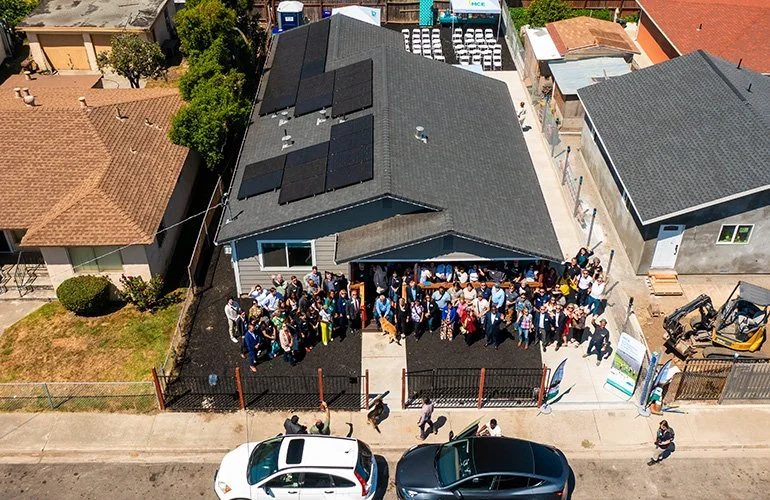
Newly renovated home in Richmond. Source: Solar Power World
WHAT WE’RE READING
Meet the sword-wielding man hired to kick squatters out of empty Oakland homes (Oaklandside)
Insurers of Last Resort: Why Today’s FAIR Plans Need a Redesign to Address the Home Insurance Crisis (Climate and Community Institute) — new report from our friends at CCI! I will likely write about this and other insurance issues soon…
The Insatiable Energy Demands of Data Centers Could Increase Fossil Fuel Emissions in California (Capital & Main) — I recently wrote a little bit about data centers, emissions, and utility bills. Really good piece here that goes into more depth
The end of rent debt? (Vox) — talking about a recently launched effort by the Debt Collective
Schrodinger’s Element (Baffler) — conversation with Thea Riofrancos on her new book, Extraction: The Frontiers of Green Capitalism
Feel free to reply any time! I always enjoy hearing from people and getting any feedback/questions/additional thoughts.
We send these out on a somewhat weekly basis. If you don’t want to get these newsletters, feel free to unsubscribe below. If you know someone that would be interested, send me their email, or you can forward this along to them and they can use this link to subscribe.
