
🏡💚 Debt striking against corporate landlords
At the beginning of this month, a group of tenants launched the first ever rental debt strike in US history. Organized with the Debt Collective, these 9 tenants announced they would jointly refuse to pay what they call “immoral sums” of “illegally held” back rent. The target is Equity Residential, the 5th largest corporate landlord in the country.
Like many people who find themselves unstably housed, these tenants’ stories are
heartbreaking in how mundane they are. One bad break quickly snowballs into a crushing amount of debt that ripples throughout their lives.
Tay’Laur and Tay’Leah Paige missed one month’s rent in 2023 during the entertainment industry strikes, which put Tay’Leah out of work. They got approved for LA’s rental assistance program, but when the court date arrived months later, Equity Residential wouldn’t accept the rental assistance. Court dates stretched on, and their debt piled up.
At the end, they were forced to vacate their unit. For awhile they slept in their car and hotel rooms. They thought they caught a break when they got approved for affordable housing, but were later denied due to the rental debt on their credit reports.
Others, like Dani Long and Angel Speed, wracked up debt during the pandemic. Long and Speed tried to do something about it, going on strike when they learned that Equity Residential had been receiving COVID-era rent assistance checks for their unit, but their building was riddled with unsafe and unhealthy conditions.
While rent strikes are a longstanding and growing tactic used by residents to demand better conditions, this is the first coordinated strike of rental debt. Although it’s the first of its kind, this group of rent debt strikers — the EQR 9, named after Equity Residential’s stock ticker — draw inspiration from successful debt resistance campaigns.
You are likely familiar with the Debt Collective through the organizing they led previously on student debt. In 2015, 15 students who had attended a now-defunct chain of for-profit schools (Corinthian Colleges) announced they would refuse to repay their federal student loans, arguing the education they received was fraudulent. This sparked a movement across the country, highlighting the widespread and crushing effects of student loan debt. This ultimately led to billions of dollars in loan forgiveness for students of the predatory schools. It also entered into the national conversation, putting pressure on President Biden who could eliminate this debt with a stroke of a pen. While he didn’t go as far as many had hoped, before he left office the Biden administration said it had waived $183.6 billion in student loan debt.
This also isn’t Debt Collective’s first foray into addressing the housing crisis. As I wrote about back in January 2024, they also created and launched the Tenant Power Toolkit, a legal mutual-aid tool designed specifically for tenants in California who have an eviction case filed against them.
This tool has helped thousands of people facing eviction, most of whom don’t have easy access to a lawyer to walk them through the eviction process. It also began to give the Debt Collective a sense of who the biggest evictors and worst landlords were in California. Using data from the Tenant Power Toolkit, researchers found that the largest corporate landlords in L.A. were “surgically” and “deeply disproportionately” evicting Black tenants. Equity Residential was explicitly named as one of the worst of the worst — with 60.3% of their Los Angeles County evictions filed on Black tenants.
As part of the launch of the rental debt strike, the Debt Collective is back with a new online tool that can generate dispute letters for debtors to send to collection agencies, credit bureaus, and regulatory bodies. The organization will also use the tool to recruit more debtors into the strike.
The goals of this campaign mirror the success of the student loan debt campaigns: win debt cancellation and spark policies to hold bad actors accountable. They are starting with Equity Residential, and hope to soon expand to other corporate landlords. Beyond just drawing public attention to this issue, the hope is that they can flip the economics of debt collection. Right now, debt collectors can quickly and easily process claims because most people comply and don’t take any legal action. The dispute letters require the collectors to look into each case, taking time and money to investigate tenant claims.
While the problem of rental debt has existed for a long time, it really exploded in the wake of the pandemic. A report found that in 2022, 33% of third-party debt collection companies collected “tenant/landlord or rental debt” that year, compared to just 7% in 2021, 5% in 2020, and 8% in 2019. This strike comes at a time when evictions are back on the rise, and rent growth continues to outpace wages.
The issue of debt, and the position of debtors in society, exposes an oppressive reality that hangs over millions of people. As René Moya, from Debt Collective, discusses on this episode of the Hegemonicon podcast, the debtor-creditor relationship has become one incarnation of economic exploitation under capitalism — akin to the tenant-landlord relationship, and the classical worker-boss relationship. (I can’t recommend that episode enough if you’re the podcast type). This is often a hidden problem, economic precarity that is often not discussed openly due to the shame of those who face it. One of the great successes of the student loan debt campaign was having thousands of people come forward to share how this was affecting their lives — transforming their isolated private battles into collective resistance.
The dynamics of rental debt go beyond corporate landlords, and get into the many complex issues related to the housing crisis. We’ve heard from mission-driven affordable housing developers about some of the challenges they face in covering basic operating costs, and how this got compounded during the eviction moratorium when some of their residents weren’t paying rent. We can understand these issues for even the most good faith landlords, and not demonize those who are trying to affordably and stably house people. And we can also recognize the wider issue: while things like medical debt and student loan debt have received widespread attention and attempts at policy reform, rental debt has mostly been invisible.
This campaign aims to change that by directly targeting corporate landlords. Not only does this point the finger at the worst actors, it also inherently includes a bigger base of people live in their buildings and can be organized to apply greater leverage.
Another great example using similar tactics is the Veritas Tenants Association (VTA), who successfully struck and won demands against the corporate landlord Veritas in San Francisco. I also previously wrote about their success using San Francisco’s Union at Home law, which gives protections for forming tenant associations.
At the end of September, Veritas defaulted on $652 million in debt and is facing the foreclosure of 66 buildings in San Francisco. For now, organizers are making sure that the tenants know their rights as Veritas figures out if it will go into foreclosure. But with an already organized base, it also seems primed for social housing demands, pushing for the city or community to acquire the buildings and take them off the speculative market, rather than be sold to another corporate landlord.
A campaign for social housing is both about calling attention to the predatory practices that our for-profit housing system engenders, while also charting a path forward. The examples of Equity Residential and Veritas show some of the worst ways that speculative real estate metastasizes — how perfect would it be if they could also be harbingers of a future system of safe, stable, and affordable housing for all?
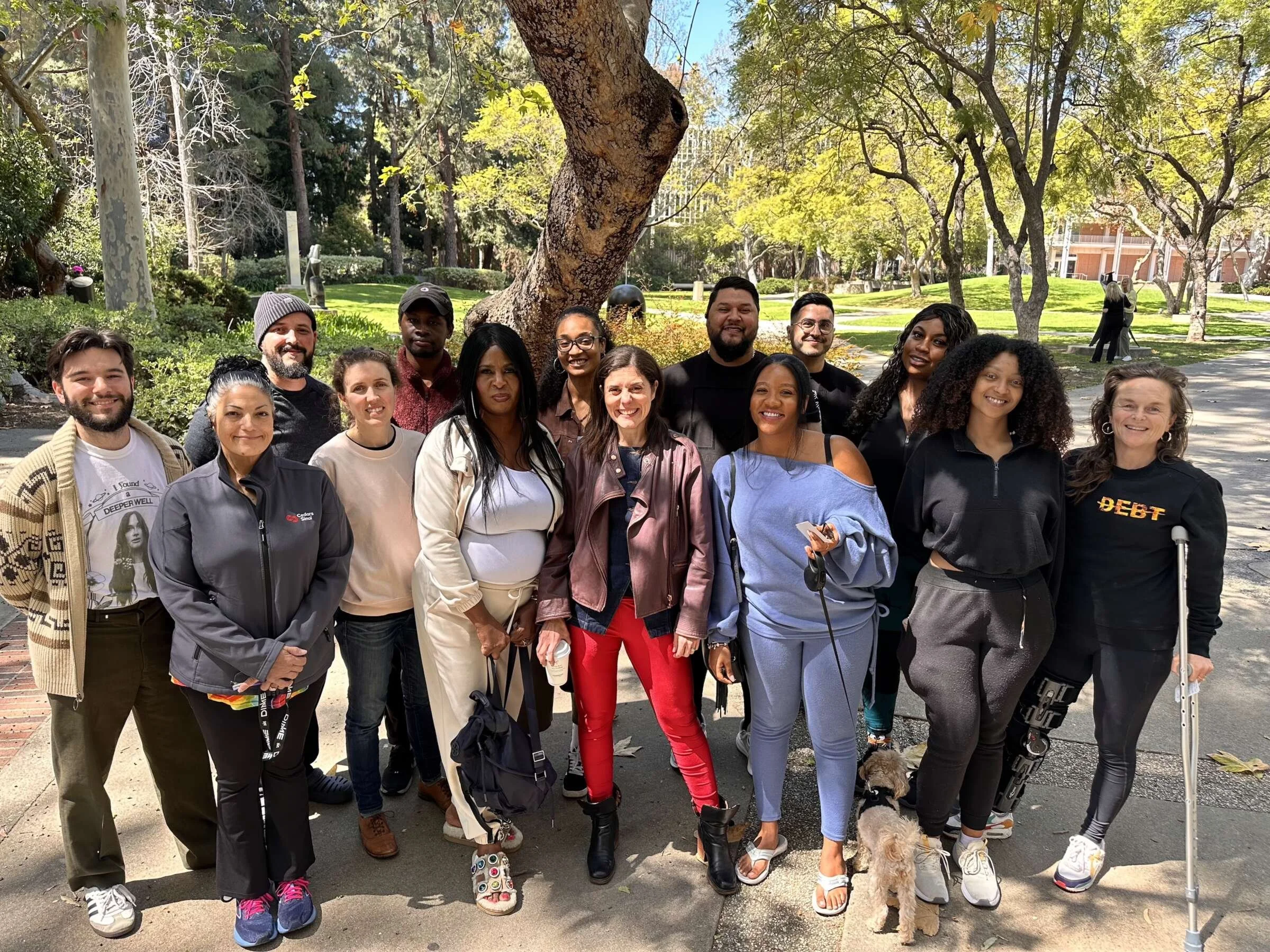
Debt Collective activists and rent debtors gather this year. Source: Truthout
WHAT WE’RE READING
In San Rafael, Residents of a Mobile Home Park Are Fighting to Keep Their Homes (KQED)
"Centering the Climate-Economy Intersection Is Our Only Way Forward" (Climate and Community Institute)
San Francisco Public Bank Supporters Eye 2026 Ballot Measure (KQED)
Farmworkers in the Hottest Part of California Find State Funds to Cool Their Homes and Save on Energy (Inside Climate News)
Corporations are buying up Altadena lots. Policies to counter that trend have so far failed (LAist)
Mixed-Income Neighborhood Trusts Aim To Capture Benefits Of Gentrification For Existing Residents (Shelterforce)
Feel free to reply any time! I always enjoy hearing from people and getting any feedback/questions/additional thoughts.
We send these out on a somewhat weekly basis. If you don’t want to get these newsletters, feel free to unsubscribe below. If you know someone that would be interested, send me their email, or you can forward this along to them and they can use this link to subscribe.
