
🏡💚 2025 wrapped
It’s the time of the year for list making, reflections, and resolutions. Far be it from me to declare the Top Stories from 2025!, and yet I still find it helpful to remind ourselves what a truly crazy, heartbreaking, and historic year it was. While we’re living it and rolling with the punches of everyday life, it’s so easy to lose sight of what’s normal. The 24 hours news cycle disappears huge news stories as fast as they happen, and the collective amnesia that follows makes it feel like we can’t tell important events from fleeting headlines.
So in the spirit of the season, here are some of the events, stories, and political changes that most influenced my thinking and our coalition’s work this year:
Fires in LA
We have to start with the same way this year started. Barely a week into the new year, the Eaton and Palisades fires devastated Altadena, Palisades, and surrounding communities of LA. The official death toll lists 31 fatalities, but a study released in August estimated the actual number is closer to 440. The fires destroyed over 18,000 homes and other structures, and insured losses made these the costliest wildfires ever.
This was a climate disaster, plain and simple. As with all climate impacts, it was compounded by gaps, failures, and inequities in our infrastructure and policies. But it was the combination of high Santa Ana winds, drought, and warmer seasons that left a tinderbox of dried out vegetation susceptible to massive, uncontrollable blazes.
The immediate aftermath and longer term recovery have followed the increasingly familiar pattern of disaster capitalism. We saw rent price gouging, unsolicited offers on impacted homes, and a huge increase in corporate real estate acquisitions that accelerate gentrification in the historically Black neighborhoods of Altadena. In the ensuring weeks, toxic soil was dumped in certain neighborhoods, and others were just left with contamination in place.
The rebuilding process has been uneven and fraught. The first home reportedly “rebuilt” in Altadena was actually just an ADU conversion of a burned garage. Just a few weeks ago, Mayor Bass touted the first house rebuilt in the Palisades area — only problem is, its owned by a homebuilding company that doesn’t plan on having anyone live in it, but instead will use it as a model property for what the company could build for Palisades residents.
All of this laid bare the need for green social housing. As long as housing is primarily treated as a commodity for profit, these increasingly frequent and devastating disasters will follow free market logic: skyrocketing rents from increased demand, land sold under duress to the highest bidder, homes rebuilt in unsafe areas. Local residents responded by creating the Altadena Community Land Trust, hoping to keep land in housing within community control. Efforts like this should be seen as the vanguard of a much more just and common sense approach to disasters, with the government and community working together to stabilize a devastated region.
Unfortunately we know that there are more climate disasters to come in our future. We can learn so much from the organizers and community leaders in LA, and prepare ourselves to step into those moments of crisis with bold demands and a plan to win.
Politics of Removal
Deportation. Eviction. Occupation and expulsion.
The second Trump administration is an avalanche of horrors that takes many forms and has many targets. But there’s one common thread through much of it, something that has seeped into the policies of even our progressive cities and states: a politics of removal.
The ICE raids are one of the most defining issues of the year, with daily terrifying and almost unbelievable videos of people being kidnapped off the street. While this is a new extreme that has shocked our conscience, they follow a logic has become very common. Ultimately, this is about the forcible removal of people from their homes. From Gaza, to homeless encampment sweeps, to everyday evictions, we are increasingly sent the message that there are some people who belong, and others who don’t; some who are allowed to call a place home, and others who can’t.
These things swirl together and build off each other. Like the landlord in Oakland’s Fruitvale district threatening his tenants with deportation, or how ICE raids in LA have pushed tenants toward eviction.
We must identify and oppose these politics wherever we see it. When things get tight, the pressure’s on, and money and resources contract, it’s far too habitual to retreat into our corners, horde what’s ours, and punch down on a powerless minority. This is the politics of MAGA and fascism. It’s our task to counter this and organize with a politics of solidarity.
The Collapsing Climate Consensus
If you haven’t read it already, I’d highly recommend Kate Aronoff’s piece in The New Republic about The Quick and Shameful Death of Biden’s Biggest Policy. With everything going on, we probably haven’t really grieved the loss of the Inflation Reduction Act (IRA). And with good reason — for people on the climate left, we never really owned this bill as our own. After all the watering down and negotiating, the IRA was mostly climate policy qua tax credits, far away from the Green New Deal vision that was its catalyst.
But in many ways, the IRA was the culmination of an incredible amount of organizing and work, of which the Green New Deal moment was a part. It took many, many years to make climate an issue that could be the centerpiece of a policy agenda, and more than that, to understand climate as an economic issue that could be addressed through an ambitious industrial policy.
The unceremonious terminating of the IRA was just not an undoing of many years of work (and trust me, as someone who spent a lot of time both advocating for things within the IRA, like Justice40 and the EJ grants, and then working on implementation, I know the disheartening feeling that we wasted our time). It also shifted the politics around climate change, and the coalition of consensus that had built over time.
One of the most influential pieces to me personally that I read all year was Ted Fertik’s analysis in Phenomenal World about The Anti-Climate Common Sense. In it, he discusses the long trajectory that eventually created a common sense around decarbonization — essentially, the expectation by governments and firms that we would have a carbon-constrained future, and that we all need to act accordingly. The shredding of the IRA also tore up that consensus. One of the takeaways from the death of the IRA is that any future climate legislation could be rolled back just as easily. As a result, rather than assuming that fossil fuels will come to an end sometime in the foreseeable future, firms are now re-hedging their bets.
This does not portend the end of climate action. The IRA was a fragile coalition of environmentalists, green capitalists, China hawks, and community groups all coming together to create a policy package that was easy to destroy because it barely touched anyone’s lives directly. Another coalition can be built, one that might be able to win something much stronger and more durable.
Abundance and YIMBY
In the meantime, we have a new ascendent political coalition. In the world of climate and housing, the Abundance book by Ezra Klein and Derek Thompson was one of the most consequential events of the year. It set off a discourse that far outlasted the typical half-life of books about policy, one that was unavoidable even if you desperately wanted to avoid it.
In California, it supercharged a YIMBY movement that had been building for a decade. Abundance was pitched as a political prescription for a unmoored Democratic Party, and Gavin Newsom took it and ran. This led directly to the CEQA reform package included in the state budget where he called out YIMBY and Ezra Klein by name (“Go YIMBY. Thank you for your abundant mindset. That’s a plug to Ezra.”).
While this has really taken hold in California, it has yet to be fully exported to the rest of the country. But I can pretty much guarantee that will happen. This will definitely be a major point of debate amongst the chaotic field of Democratic candidates for Governor in California, and it will almost certainly be a part of the 2028 Presidential race as well.
Our campaign for green social housing offers one alternative framework with solutions to the housing and climate crisis. Rather than doubling down on market logic, we make the case that the path forward is to decommodify land and housing. The opposition is not environmental justice and equity groups, but a system that treats housing as a commodity for profit, instead of one that provides it as a human right.
Green Social Housing
This alternative framework is building its own momentum. In February, Seattle won a landmark victory taxing the rich to pay for social housing. In May, Chicago followed by passing an ordinance to create a Green Social Housing authority for the city. In one of the brightest political moments of hope, Zohran Mamdani won the New York City mayoral election promising to freeze the rent, and with the potential for a new era of social housing in New York.
Across California, the demands for green social housing are building. Community land trusts are growing in strength and numbers. Calls for Land Back are returning land to indigenous stewardship. Municipalities are considering new forms of public development, utilizing public land for public good, and considering the potential for a more assertive approach to public financing.
Through the SB 555 social housing study, a new crop of stakeholder groups, tenants, academics, and community organizations are grappling with the design of a statewide social housing program. Our coalition has been deeply engaged in that study, researching and advocating for a systemic approach to creating social housing at scale. That work continues into next year, and I hope you’ll join us.
There’s so much more I could highlight and say. From rising utility bills, AI data centers, techno-fascist ideology, the home insurance crisis, to much more, it’s been a crazy year. For now, I’ll wrap this year with a cliché but very real message of gratitude to you all: to everyone who has participated in our coalition in any way, big or small, thank you. It’s an honor to get to work alongside so many passionate and talented organizers and advocates. And though this year has brought a lot of darkness, being in it together with you all still makes it seem like a better world is possible.
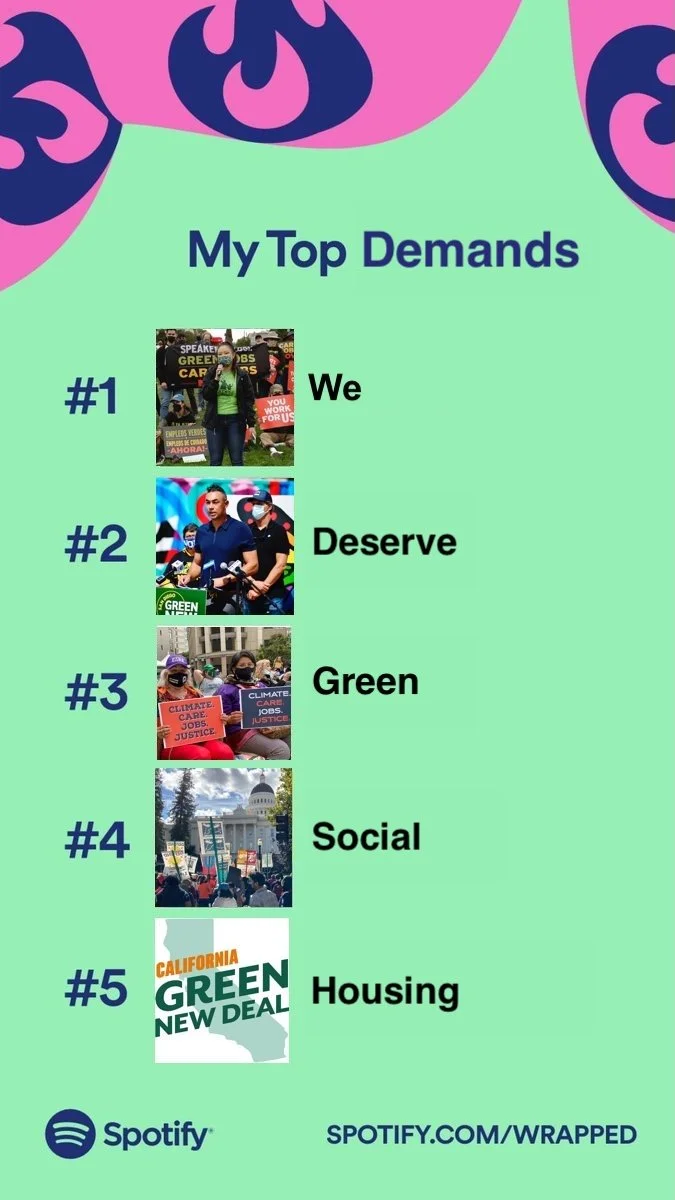
That’s a wrap!
WHAT WE’RE READING
Mentioned throughout this newsletter, here are some of my favorite pieces from this year:
The Quick and Shameful Death of Biden’s Biggest Policy (New Republic)
The Anti-Climate Common Sense (Phenomenal World)
Power Brokers (Harpers) — what’s really behind your soaring utility bills
Organize, Industrialize, Decarbonize! A Pro-Worker, Green Industrial Policy for California (UAW Region 6)
The Growing Fight for Green Economic Populism (In These Times)
The Climate Crisis Hits Tenants Hardest. They’re Fighting Back. (Shelterforce)
Feel free to reply any time! I always enjoy hearing from people and getting any feedback/questions/additional thoughts.
We send these out on a somewhat weekly basis. If you don’t want to get these newsletters, feel free to unsubscribe below. If you know someone that would be interested, send me their email, or you can forward this along to them and they can use this link to subscribe.
