
🏡💚 Be cool, freeze the rent
In a huge win for tenants, LA City Council voted last week to lower the cap on rent increases for rent-stabilized apartments to 4%. This is the first time the city has overhauled its rent increase formula since 1985.
Under LA’s current rent control formula, landlords have the ability to raise rent at least 3% every year, and can raise it by as much as 10% depending on inflation and if they pay for utilities. Now the maximum increase will be somewhere between 1% and 4% depending on inflation.
This is a hard fought victory for tenants, led by the Keep LA Housed coalition, that will impact millions of people. The city’s rent control rules cover units built before 1978 that fall under the Los Angeles Rent Stabilization Ordinance (LARSO). Nearly two-thirds of LA residents live in rental housing, and since so many of them live in older buildings, the rent control rules affect about 42% of all households in the city.
This was actually the negotiated deal, as Councilmember Nithya Raman had initially proposed a maximum increase of 3%. For her and other supporters, this reform is long overdue. “The city has not done enough to protect renters,” said Councilmember Raman. “What we have right now is an opportunity to make L.A. more affordable, because when people can afford to stay in Los Angeles, this entire city thrives.”
Sound familiar? Well, it might sound familiar because the housing crisis is everywhere, and many cities have experienced significant displacement of long-term residents who can no longer afford to live there. But it also sounds an awful lot like the winning message of a certain democratic socialist on the other side of the country.
Indeed, this feels inextricable from the progressive economic populism platform championed by Zohran Mamdani during his historic victory in the mayoral election in New York City. One of his top priorities and campaign pledges was to freeze the rent for all rent-stabilized apartments. This is an extremely popular policy, with one pollshowing 78% of New Yorkers in support. It’s also a policy that Zohran can definitely deliver on; in New York, the mayor has sole power to appoint the nine members of the Rent Guidelines Board, which sets the rates each year for rent-stabilized apartments.
As Zohran explained in one of his many viral campaign videos (in this one, taking the the polar plunge to talk about freezing… the rent), last year the city’s Rent Board found that landlord incomes rose by nearly twice the increase of their expenses. But for struggling renters, any rent increase could be the difference between them staying or leaving the city.
Still, in LA, as in New York, there was fierce opposition to these changes that follow the anti-rent control playbook. And while it’s good to understand these as real estate industry talking points, it’s also worth engaging with the substantive policy arguments because they have real world impacts.
There are many different arguments that landlords and the real estate lobby use, but I’ll focus on two that I think are the most persuasive, and have special resonance in the current political environment:
Anti-rent control argument #1: Rent increase caps will mean less repairs
The logic here is pretty straightforward. Landlords aren’t willing to take (even a temporary) loss on their properties, and certain repairs and home upgrades are pretty expensive. Without the ability to immediately recoup those costs, landlords just won’t do them. That means pushing off that roof replacement, not fixing the leaky windows, and certainly not springing for a new induction stove or solar panels. For decarbonization advocates, this argument can be persuasive, and threatens to create fractures in an enviro-housing coalition.
Anti-rent control argument #2: Rent control will decrease new housing production
Rent control has long-been a bugaboo for traditional economists, arguing that market regulation necessarily hinders supply (and then they might do the thing where they put their arms in an X formation to illustrate the supply and demand graph as a unshakable law, QED). If developers are limited on a project’s return on investment, so the argument goes, then they won’t build. This is why many developers (though not all!) oppose rent control, as do groups like YIMBY Action who emphasize housing supply above all else.
If taken in good faith, these are reasonable tradeoffs to consider. And I think there’s some truth to them, though the reasons to repair or build housing are much more complex than one regulation. But these arguments alone don’t capture the full political reality of housing politics, nor the broader housing agenda that rent control can be a part of.
This is what makes Zohran’s messaging so clear. He agrees that we need to expedite and build more housing. But he also knows it’s not enough. In an article in The Atlantic, Mamdani said “We absolutely have to expedite the process by which we build new housing. But we can’t do that unless we also address people’s immediate needs.”
As in New York, communities across California that are hit hard by the housing crisis are often also critical of policies designed to build more units. They know that those new units take years to build, and the potential benefits of lower rents that new supply could bring would take even longer. Meanwhile, it looks more like gentrification and the accelerated displacement of existing residents.
Zohran argues that freezing the rent is not just a way of delivering relief from exorbitant housing costs; it is also the only way to get people on board with a growth agenda.
This is a key insight that I think many climate and clean energy advocates need to take to heart. In order to gain support for urgent and fast decarbonization policies and community investments, people need to feel stable, and know that they will actually be around to benefit from those changes. That’s a big reason why the California Green New Deal Coalition has been supporting the campaign to close the renoviction loophole — a state policy that allows landlords to evict tenants if they do a substantial renovation.
This insight also has the potential to chart a path out of the false choice between supporting new development or protecting tenants. A winning housing agenda should understand that immediate material benefits is how you build support for new supply.
But this doesn’t necessarily address the first argument about repairs and habitability. Once again, this is where it’s important to understand this within a much bigger housing agenda. The issue of housing conditions and housing quality are often overlooked, so in many ways it is really helpful to draw it out into the light. Why are our rental properties so often in bad shape? Would landlords make those changes if the rent cap wasn’t changed (and if so, why haven’t they done them already)?
If paired with stronger code enforcement and public investment (say, a whole-home retrofit / equitable building decarbonization program), there’s the potential for a strong housing agenda that clearly works in favor of improving habitability issues and quality of life.
But we can be a lot more ambitious than that. If done at scale, a green social housing program could move the needle much further. Rather than sitting back and hoping that regulations will properly guide the market, the public sector can step in and act as a non-speculative actor, purchasing buildings when the landlord is no longer interested in ownership. Don’t want to do the repairs needed to bring your building up to code? Think you can’t decarbonize your building within the required timeline to phase off fossil fuels? We’ll take it off your hands. A well-capitalized green social housing program, without a profit motive and with a suite of tax and finance tools, could intervene in the housing market to put housing quality first and property values second. A public social housing entity can effectively serve as a community land trust (and could work alongside to support non-government community land trusts!), holding land and housing in a bigger portfolio that can pursue asset management at scale.
This combination of rent control, code enforcement, public investment, and green social housing would be a comprehensive approach to delivering affordability. In Sacramento, the politics of housing have decidedly swung towards an all-out press to build, build, build. And while I agree that we should support the construction of new units (especially green and affordable ones), we need to situate this within a bigger housing agenda that actually benefits people who are struggling right now. AB 1157 is a two-year bill that seeks to lower the statewide rent increase cap down to 5%, which would go a long way in furthering the political agenda of affordability. And as we begin looking to the Governor’s race in 2026, we know that each candidate will have to articulate their vision for tackling the housing and climate crises. We should push them to hold a comprehensive agenda of affordability, one that delivers for people right now while laying the path for transformative change in the future.
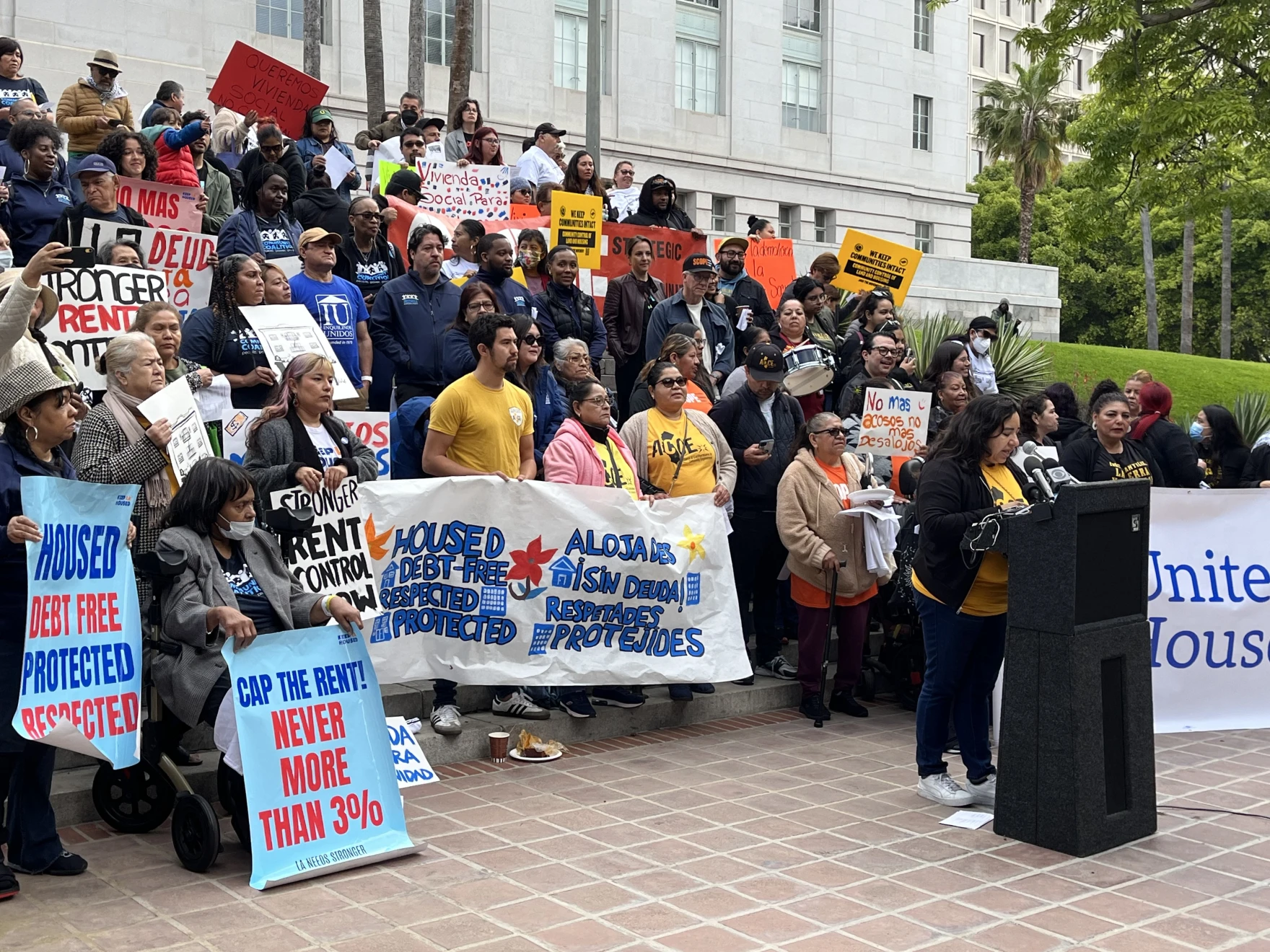
Tenants rally outside LA City Hall back in July Source: LAist
WHAT WE’RE READING
In historic vote, L.A. caps rent increases for rent-stabilized apartments at 4%(LA Times)
Fruitvale renters sue landlord over immigration threats, eviction attempts(Oaklandside)
Why Habitability Is A Growing Rallying Cry (Shelterforce)
Financial Distress in the Rental Market is Escalating (Climate and Community Institute)
Poppy Seed Bagel Progressivism or What We Talk about When We Talk about Affordable Housing Development Costs (Poverty & Race Research Action Council)
Nine months after fires, residents continue to struggle with housing stability, finances (LA Times)
Feel free to reply any time! I always enjoy hearing from people and getting any feedback/questions/additional thoughts.
We send these out on a somewhat weekly basis. If you don’t want to get these newsletters, feel free to unsubscribe below. If you know someone that would be interested, send me their email, or you can forward this along to them and they can use this link to subscribe.
